How Does a Jam Filling Machine Work?
How Does a Jam Filling Machine Work? | Mic Machinery
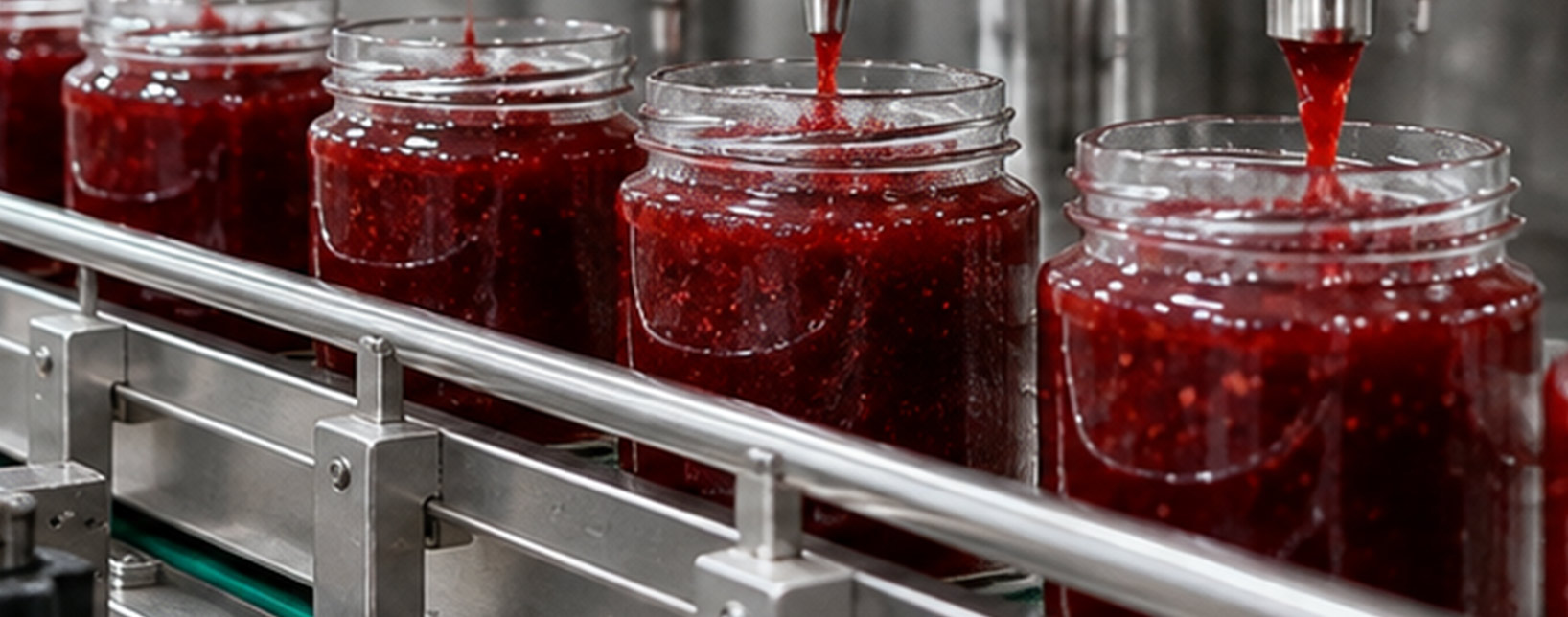
A Jam Filling Machine is designed to solve common production challenges in jam manufacturing, including inconsistent filling volume, product waste, hygiene control, and labor efficiency. MIC Machinery provides filling solutions for high-viscosity products such as jam, honey, sauce, and paste. The equipment uses precision piston filling technology, stainless steel contact parts, and adjustable filling systems to support different containers and production capacities.
How does a jam filling machine work?
A jam filling machine works by transferring jam from the hopper into containers through a controlled dispensing system. For high-viscosity materials, piston filling technology creates stable pressure to ensure accurate filling without damaging product texture.
The basic process includes:
| Working Stage | Function |
|---|---|
| Material Feeding | Jam enters the hopper and remains evenly supplied |
| Volume Measurement | Piston or servo system controls filling quantity |
| Filling Process | Nozzle releases jam into bottles, jars, or pouches |
| Container Transfer | Conveyor moves containers to the next process |
| Cleaning & Maintenance | Product-contact parts are removed or cleaned easily |
During operation, parameters such as filling speed, volume range, and nozzle quantity can be adjusted according to production requirements. MIC models include solutions from semi-automatic machines to multi-head automatic filling systems.
What type of filling machine is used for jam production?
Jam production usually requires equipment with strong adaptability because jam viscosity varies depending on fruit content, sugar concentration, and formulation.
A piston filling system is commonly selected because it provides:
· Stable filling accuracy
· Better handling of thick products
· Reduced dripping and material waste
· Flexible adjustment for different package sizes
For manufacturers producing multiple products, MIC filling equipment can also handle honey, sauces, cream, and other semi-viscous materials.
Precision Filling System for High Viscosity Products
|
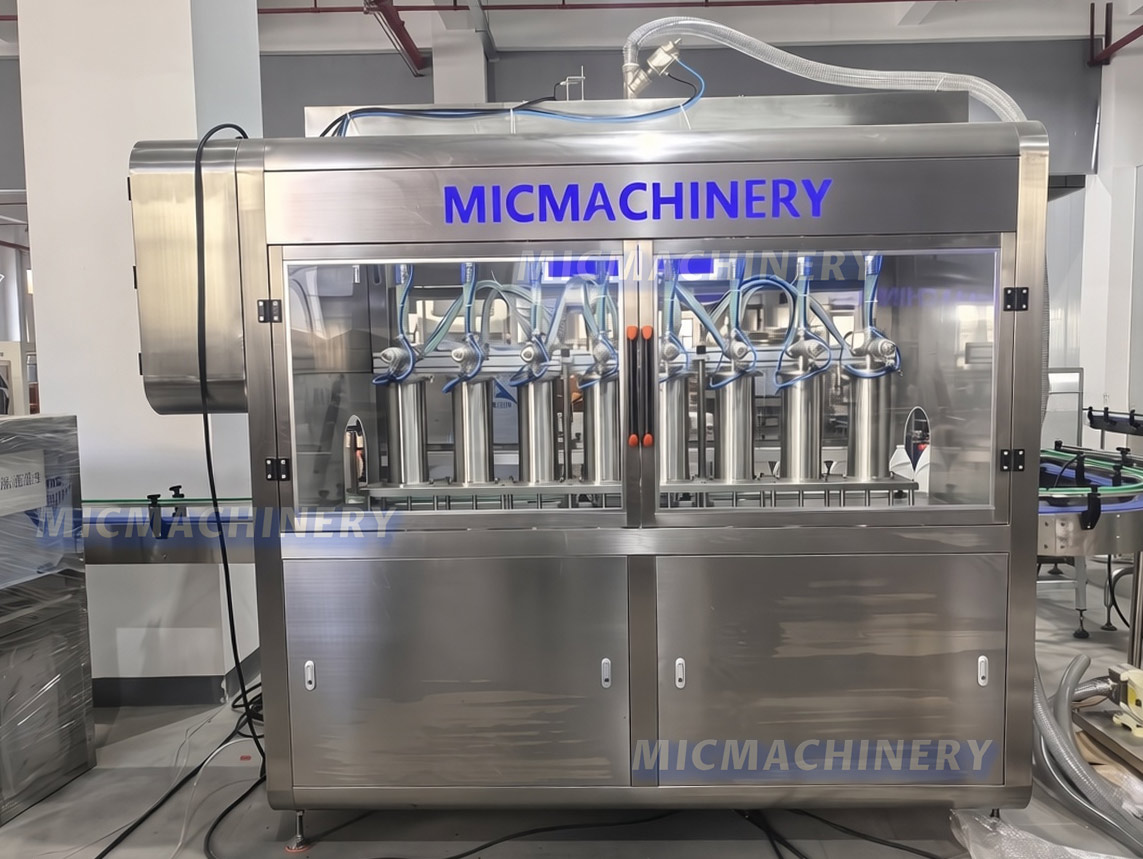
One major concern for jam producers is whether the machine can handle thick materials smoothly. MIC Machinery applies piston-driven filling technology to improve flow control. ----- Key technical features include: · Servo motor-controlled filling movement · Adjustable filling volume · Anti-drip filling nozzle design · Stainless steel food-contact components ----- For example, Jam Piston Filling Machine supports 50-1000ml filling ranges, 8 filling heads, and production speeds up to 1800 bottles per hour depending on bottle size. |
 |
Hygienic Structure and Food Safety Design
Food manufacturers need equipment that meets strict hygiene requirements. The machine frame generally uses stainless steel construction, while product-contact components are designed for corrosion resistance and easy cleaning.
Advantages include:
· Reduced contamination risk
· Simple disassembly for cleaning
· Longer service life
· Suitable for continuous production
Automation and Production Efficiency
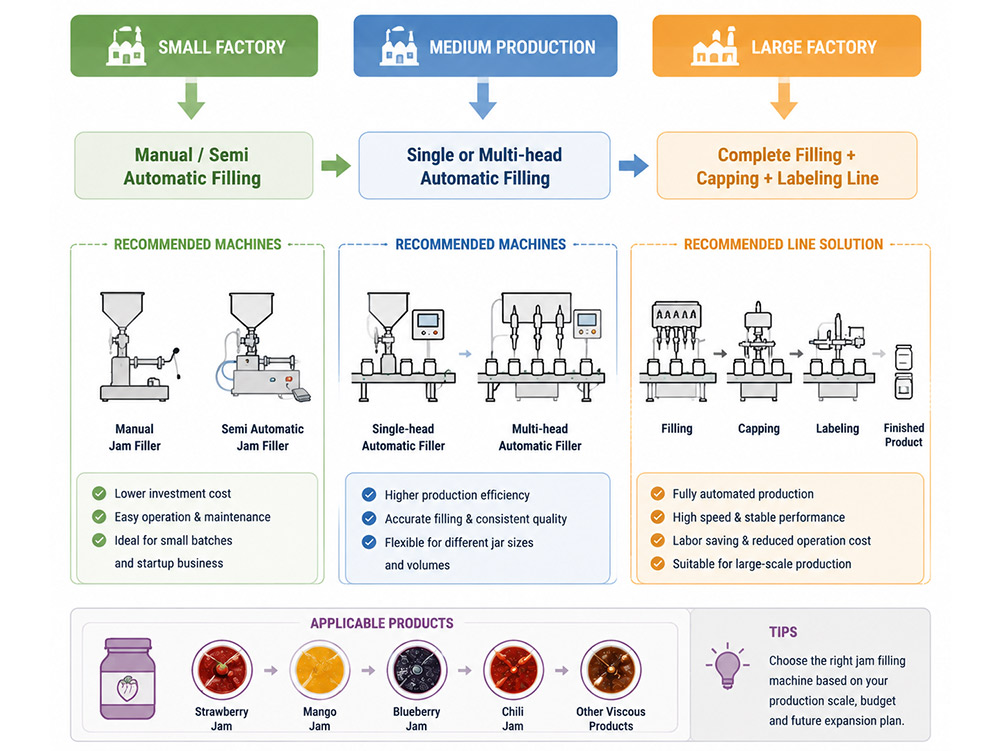
Different factories have different production targets. Small producers may require compact semi-automatic equipment, while industrial plants need integrated filling, capping, and labeling systems.
MIC Machinery provides:
· Semi-automatic filling machines
· Automatic bottle filling systems
· Multi-nozzle high-speed filling machines
These solutions help manufacturers reduce manual operation and improve filling consistency.
Comparison of Differences among Different Models
| Model Type | Application | Capacity Range | Suitable Users |
|---|---|---|---|
| Manual Jam Filling Machine | Small batch jam production | 1-50 bottles/h | Small workshops |
| Semi Automatic Jam Filling Machine | Jam, sauce, paste | 5-25 bottles/min | Growing businesses |
| Automatic Jam Filling Machine | Bottles and jars | Up to thousands bottles/hour | Industrial factories |
| Multi-head Piston Filling Machine | Large-scale production | Higher output | Commercial food plants |
When selecting equipment, manufacturers should consider product viscosity, container size, production volume, and future expansion plans.
How to choose a jam filling machine for your production line?
Choosing suitable equipment requires evaluating several technical factors:
1)Product characteristics
Jam with fruit particles or higher viscosity may require stronger piston systems.
2)Production capacity
Factories should match machine speed with market demand.
3)Container compatibility
The filling system should support different bottle, jar, or pouch formats.
4)Maintenance requirements
A modular design reduces downtime and simplifies spare part replacement.
A suitable machine not only improves production efficiency but also protects product quality during long-term operation.
FAQ
| What products can a jam filling machine fill? |
| Besides jam, the machine can handle honey, sauce, cream, paste, and similar semi-viscous materials depending on configuration. |
| Can MIC provide installation and commissioning service? |
| Yes. MIC Machinery provides technical guidance, equipment installation support, and operation training to help customers start production smoothly. |
| How often does the machine need maintenance? |
| Routine cleaning, lubrication inspection, and sealing component checks should be performed according to production frequency and material characteristics. |
| What should I do if filling accuracy becomes unstable? |
| Operators should check piston sealing parts, material consistency, air pressure stability, and filling parameter settings before adjusting the system. |
| Can one machine fill different jam products? |
| Yes. With adjustable filling parameters and suitable nozzles, one machine can support different viscosities and container sizes. |