How Does Temperature Affect Lube Oil Filling?| Mic Machinery
How Does Temperature Affect Lube Oil Filling?
Temperature directly affects lube oil filling because it changes viscosity, density, flow resistance, suction behavior, filling time, and shut-off performance. As lubricant temperature rises, many oils become less viscous and flow more easily; as temperature falls, viscosity generally increases, which can slow filling and change the behavior of pumps and nozzles. For this reason, a Lube Oil Filling Machine should be evaluated using the product’s actual temperature range at the filling point—not ambient room temperature alone. MIC Machinery’s current lube oil filling solutions use piston, gravity, flowmeter, weighing, and tracking configurations that can be matched to different lubricant characteristics and production requirements.
Why Does Temperature Change Lube Oil Flow?
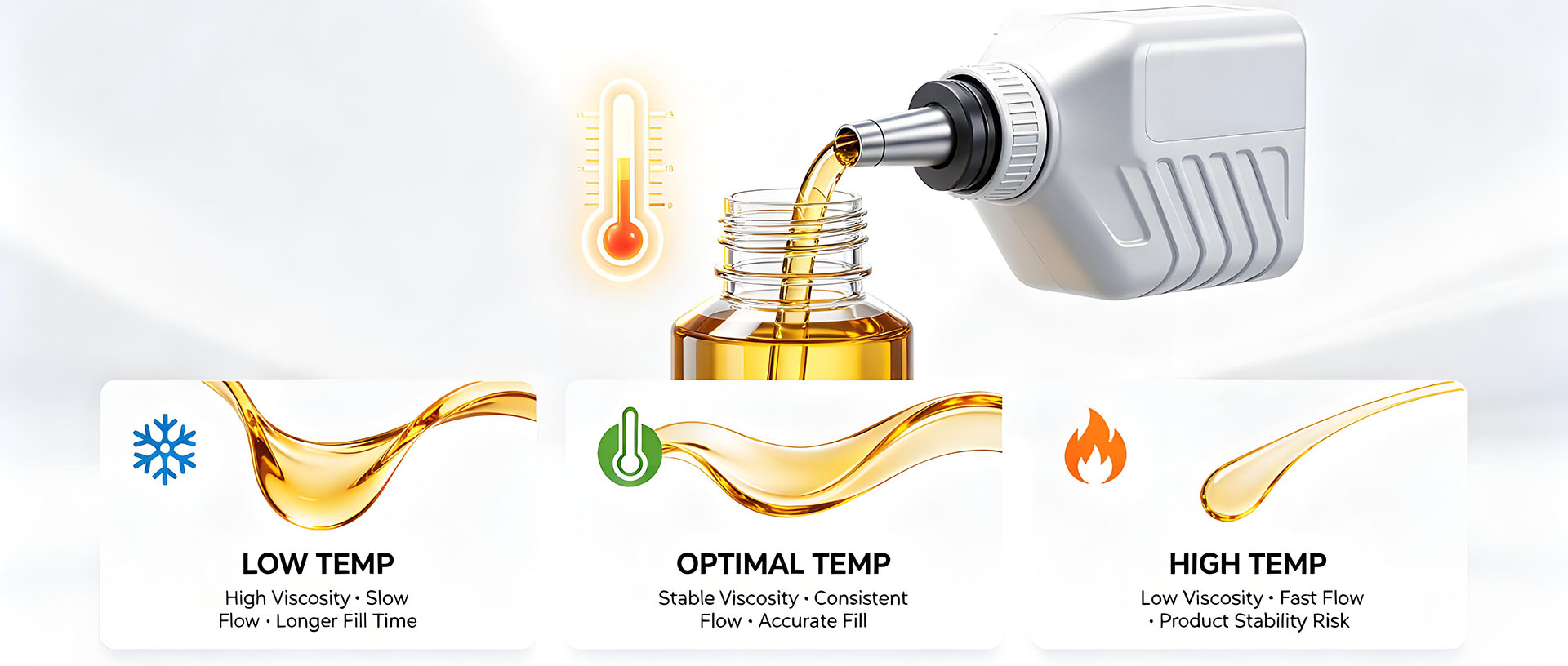
Temperature changes the physical behavior of lubricant during filling. The most obvious effect is viscosity: when many lubricating oils become colder, their resistance to flow increases; when heated within an appropriate operating range, they can become easier to pump and dispense.
However, viscosity is not the only variable. Temperature can also influence density, volumetric expansion, air release, pump load, filling time, and the way oil separates from the filling nozzle. Industry filling guidance therefore recommends considering viscosity and operating temperature together when specifying lubricant filling equipment.
For example, a gear oil that flows smoothly during a warm afternoon production shift may behave differently during a cold morning startup. If the filling parameters remain unchanged, the machine may require more time to reach the target volume or may experience different shut-off behavior.
Temperature, Viscosity and Flow Relationship
| Temperature Condition | Typical Oil Behavior | Possible Filling Effect |
|---|---|---|
| Lower temperature | Higher viscosity | Slower flow and longer filling time |
| Stable operating temperature | More consistent viscosity | More repeatable filling |
| Excessive temperature | Lower viscosity / possible product changes | Different flow rate or dosing behavior |
| Rapid temperature fluctuation | Changing viscosity and density | Variable filling performance |
The actual response depends on the lubricant formulation, viscosity grade, additives, container, pump and filling technology. Therefore, these effects should be verified using the actual product rather than assumed from temperature alone.
How Does Temperature Affect Filling Accuracy?
Filling accuracy can be influenced by temperature in both volumetric and flow-based systems.
A lubricant's viscosity affects how quickly it passes through the product pipeline, pump, valve and nozzle. When temperature changes alter viscosity, the filling system may experience different flow conditions. Temperature can also change liquid density and volume, which is particularly relevant when the product is measured volumetrically.
MIC's current Lube Oil Filling Machine page specifically identifies temperature and viscosity as factors that can affect filling behavior and states that controlled flow, accurate dosing and suitable metering technology are important for consistent output.
Why Temperature Stability Matters
Suppose a filling line is calibrated under one temperature condition and then the lubricant becomes substantially colder. The product may require a longer filling period because of increased flow resistance. If the process relies on fixed timing or uncontrolled flow, the actual filling result can change.
This does not mean that every temperature change automatically causes an inaccurate fill. A properly configured system can compensate through suitable metering technology, controlled filling parameters and product testing.
The important principle is:
Temperature change → viscosity/density change → flow behavior change → filling parameters may need adjustment.
Does Higher Temperature Make Lube Oil Easier to Fill?
Often, increasing the temperature of a high-viscosity lubricant within its approved processing range can reduce viscosity and improve flow. This can make pumping and filling easier and may reduce filling time.
However, higher temperature is not automatically better.
The lubricant manufacturer may specify a temperature range for processing. Excessive or uncontrolled heating can affect product properties, additives, foaming behavior, material compatibility or packaging conditions.
For this reason, a filling machine should not be designed around the assumption that “hotter oil fills faster.” The correct approach is to determine:
- Product viscosity at the actual filling temperature
- Recommended processing temperature
- Required filling volume
- Target production speed
- Pump and metering requirements
- Nozzle shut-off behavior
- Product stability during heating
Recent lubricant filling guidance similarly recommends confirming product viscosity, filling temperature, foaming characteristics and compatibility before final machine configuration.
How Does Temperature Affect Different Lube Oil Filling Methods?
Different filling technologies respond differently to changes in lubricant characteristics.
| Filling Method | Temperature Sensitivity Consideration | Typical Application |
|---|---|---|
| Piston Filling Machine | Viscosity affects product intake and discharge | High-viscosity oils and controlled volumetric filling |
| Flowmeter Filling | Flow characteristics affect measurement stability | Continuous automatic filling |
| Gravity Filling | Flow resistance strongly affects filling rate | Suitable for more free-flowing oils |
| Weighing Filling | Measures mass rather than relying only on volume | Larger containers and industrial packaging |
| Tracking Filling | Product flow must remain synchronized with moving containers | High-speed bottle lines |
MIC currently offers Motor Oil Piston Filling Machine, Automatic Engine Oil Gravity Filling Machine, Automatic Lube Oil Tracking Filling Machine, Automatic Lube Oil Weighing Filling Machine, and other configurations. Its listed filling volumes range from small bottles to 30 L containers, with separate barrel systems for 200 kg and 1,000 kg applications.
This means temperature should be considered together with the selected filling principle rather than treated as an independent specification.
When Is a Heated Filling System Necessary?
A heated filling system may be considered when a lubricant becomes difficult to transfer or dose at the normal production temperature because of high viscosity.
For example, certain high-viscosity gear oil or industrial lubricants may require controlled temperature management to achieve a stable flow condition. Industry guidance for viscous lubricant products recommends holding the product within a defined temperature range because viscosity changes with temperature.
A heated system may be useful when:
- The lubricant has a large viscosity change over the normal operating range.
- Cold-start filling is significantly slower.
- Pump load increases at lower temperatures.
- Filling time becomes inconsistent.
- Stable product flow is required for repeatable dosing.
Heated Tank vs. Heated Filling System
These terms should not be treated as identical.
A heated tank controls product temperature during storage or preparation, while a complete temperature-controlled filling system may also require attention to the:
Tank → Pipeline → Pump → Filling Valve → Nozzle
If the oil is heated in the tank but loses substantial heat before reaching the filling nozzle, the viscosity at the actual filling point may differ from the value measured in the tank.
Therefore, temperature should be checked where the product is actually being filled.
How Should Lube Oil Temperature Be Controlled During Filling?
A practical temperature-control strategy begins with establishing the lubricant's acceptable processing range.
1. Determine the Product's Viscosity-Temperature Relationship
Obtain the lubricant's technical data and identify how viscosity changes over the expected operating temperature range.
2. Measure Temperature at the Filling Point
Do not rely exclusively on the factory's room temperature or storage tank temperature. The temperature inside the product line can be different.
3. Maintain Stable Product Supply
MIC's filling process uses a buffer tank to provide stable product supply and pressure to the filling system. This helps create more consistent conditions before the metering stage.
4. Match Pump and Metering Technology
A servo-controlled piston system can provide controlled displacement for high-viscosity lubricants, while flowmeter or weighing systems may be more appropriate for other products and packaging formats. MIC specifically lists a servo piston system for high-viscosity lubricant applications.
5. Validate the Complete Filling Cycle
Temperature should be checked during:
Product Supply → Pumping → Metering → Filling → Nozzle Shut-Off
This is more reliable than validating only the product temperature in the storage tank.
How Does Temperature Affect Filling Time and Pump Load?
When lubricant viscosity increases, the filling system may need more force or time to move the same quantity of oil through the pipeline and nozzle.
This can affect:
- Pump load
- Filling speed
- Cycle time
- Product pressure
- Nozzle shut-off
- Production capacity
A recent lubricant filling application guide similarly identifies viscosity, temperature, fill volume and required cycle time as factors that need to be evaluated together when configuring pumps and nozzles.
For a high-speed production line, this is particularly important. If the filling cycle becomes longer because of colder, more viscous oil, the nominal machine speed may no longer represent the practical production rate.
Example of the Process Relationship
Lower Temperature→Higher Viscosity→Higher Flow Resistance→Longer Filling Time / Higher Pump Demand→Potential Change in Production Rate
This is why production capacity should be validated using the actual lubricant and operating temperature.
How Does Temperature Affect Nozzle Shut-Off?
Temperature can also influence what happens at the end of the filling cycle.
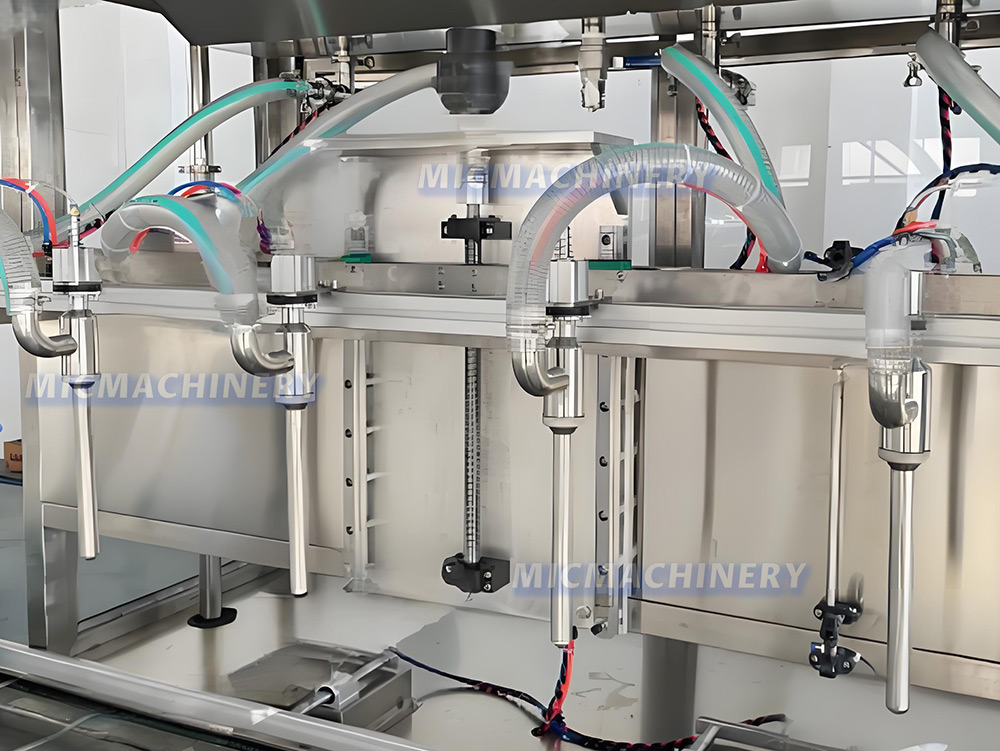
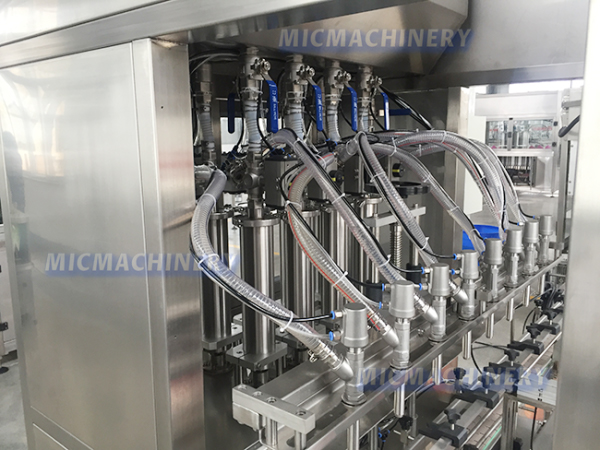
High-viscosity lubricant can leave a small amount of product at the nozzle tip. If temperature changes increase viscosity or alter flow characteristics, the nozzle may require different shut-off behavior.
MIC's current filling process uses controlled filling speed, diving nozzles where appropriate and anti-drip valves at the end of the filling cycle. The system is designed to reduce leakage and residue on container surfaces.
For particularly viscous lubricants, nozzle selection should therefore be considered together with:
- Product temperature
- Oil viscosity
- Filling speed
- Nozzle diameter
- Shut-off timing
- Anti-drip mechanism
A temperature problem cannot always be solved by changing the nozzle, and a nozzle problem cannot always be solved by heating the oil. The complete filling system needs to be evaluated.
Which MIC Lube Oil Filling System Is Suitable for Temperature-Sensitive Products?
MIC provides several configurations that can be matched to different lubricant properties and packaging requirements.
| MIC Configuration | Listed Filling Range / Capacity | Temperature-Related Consideration |
|---|---|---|
| Motor Oil Piston Filling Machine | 100 ml–5,000 ml configurations | Suitable for controlled volumetric filling of viscous oils |
| Automatic Engine Oil Gravity Filling Machine | 50 ml–5,000 ml | More dependent on product flow characteristics |
| Automatic Lube Oil Tracking Filling Machine | 50 ml–5 L | Suitable for synchronized automatic bottle filling |
| Automatic Lube Oil Weighing Filling Machine | 5–30 L | Useful for larger-volume lubricant packaging |
| Lube Oil Piston Filling Machine | 50–1,000 ml listed configuration | Designed for controlled piston dosing |
| Semi-Automatic Lube Oil Barrel Filling Machine | 200 kg / 1,000 kg | Intended for large industrial containers |
The listed machine specifications are reference configurations. Actual output and filling performance depend on the lubricant, container, filling volume, temperature, viscosity and selected machine configuration.
Key Factors to Check Before Selecting a Lube Oil Filling Machine
Temperature should be included in the equipment specification sheet rather than treated as an afterthought.
| Parameter | Information to Provide |
|---|---|
| Product | Engine oil, gear oil, hydraulic oil, etc. |
| Viscosity | Actual product viscosity |
| Temperature | Minimum, normal and maximum filling temperature |
| Filling volume | 500 ml, 1 L, 5 L, 20 L, etc. |
| Container | PET, HDPE, metal can or drum |
| Capacity | Required bottles/hour or containers/hour |
| Accuracy | Target filling tolerance |
| Product grades | Single or multiple oils |
| Foaming | Low, medium or high |
| Heating | Required / not required / to be tested |
| Nozzle | Standard, diving or anti-drip configuration |
Providing these parameters allows the filling system to be selected around the actual process rather than around a generic machine speed.
FAQ About Temperature and Lube Oil Filling
Does temperature affect lube oil filling accuracy?
Yes. Temperature can change lubricant viscosity and density, which can affect flow behavior and, depending on the filling principle, filling consistency. The actual effect depends on the product and machine configuration.
Does heating lube oil improve filling speed?
It can when controlled heating reduces viscosity and improves flow, but higher temperature is not automatically better. The lubricant's approved processing range and formulation stability should be confirmed first.
What happens when lube oil is too cold for filling?
Higher viscosity can increase flow resistance, potentially increasing pump demand and filling time. The actual effect should be verified using the specific lubricant.
Does temperature affect piston filling?
Yes. Temperature-related viscosity changes can influence product intake and discharge behavior. A properly configured piston system and stable product conditions can help maintain repeatable filling.
Does temperature affect gear oil filling?
Yes. Gear oil can be relatively viscous, and its flow behavior can change with temperature. Pump, nozzle, filling speed and temperature should therefore be evaluated together.
Is a heated filling system required for all high-viscosity oils?
No. Heating is application-dependent. It should be considered when the lubricant's viscosity at the normal production temperature makes pumping or filling difficult.
Where should lube oil temperature be measured?
Ideally, temperature should be verified at or near the actual filling point, because the product temperature can change between the storage tank and filling nozzle.
Conclusion
Temperature is an important process variable in Lube Oil Filling Machine applications because it can influence viscosity, density, flow resistance, pump load, filling time and nozzle shut-off behavior. The objective is not simply to make the oil hotter, but to establish a stable and product-compatible filling temperature and maintain it consistently through the actual filling process.
For high-viscosity lubricants, the machine configuration may combine a servo piston or other suitable metering technology with controlled product supply, appropriate nozzles and anti-drip shut-off. MIC's current lube oil filling solutions include piston, gravity, tracking and weighing configurations that can be adapted to different filling volumes and lubricant packaging formats.