How to Choose a Detergent Filling Machine for Laundry?
How to Choose a Detergent Filling Machine for Laundry
If you are setting up or scaling a laundry detergent production line, the first question you will ask is: how to choose a detergent filling machine for laundry that is accurate, fast, and reliable? The short answer is that the right detergent filling machine depends on four things — the viscosity of your liquid detergent, your container type (bottle, pouch, or pail), your target filling speed, and your budget. A liquid detergent filling machine must control foam, hold precise volume, and run continuously without downtime. In this guide, we break down the machine types, key selection criteria, and a full filling machine for liquid detergent parameter comparison, so you can make a confident, purchase-ready decision.

What Is a Detergent Filling Machine?
A detergent filling machine is automated equipment that doses and fills liquid cleaning products — laundry detergent, dishwashing liquid, liquid soap, and industrial washing agents — into bottles, stand-up pouches, sachets, or pails. Unlike simple liquid fillers, detergent filling requires controlled flow dynamics, anti-foam filling performance, and corrosion-resistant materials because many detergent formulations contain surfactants, fragrances, and mildly corrosive chemical components that affect both flow behavior and equipment durability.
Key Factors to Consider When Choosing a Detergent Filling Machine
1. Filling Accuracy
Filling accuracy is the most important metric for a liquid detergent filling machine. In high-volume production, even a small over-fill or under-fill per bottle multiplies into significant profit loss or customer complaints. Look for machines with precise volumetric or weighing control, and check the repeatability in milliliters. MIC Machinery’s filling machines use precise volumetric control and can be configured to weighing-based filling for large containers.
2. Foam Control
Detergents generate foam during filling, which can cause spills, inaccurate volume, and sealing problems. A good detergent filling machine is designed with anti-foam filling performance — using bottom-up filling nozzles, controlled flow rates, and foam-reducing components. This is one of the key differences between a detergent filling machine and a general-purpose liquid filler.
3. Filling Speed and Output
Your required output determines the machine class. For small-scale start-ups, a semi-automatic piston filler may be enough. For a full production line, you will need a fully automatic machine rated in bottles per hour (BPH) or pouches per minute. For example, an 8-head piston machine handles about 2,000–2,400 BPH at 1L, while a 12-head gravity machine reaches 2,400–2,800 BPH at 1L.
4. Filling Volume Range
Choose a machine whose filling volume range matches your product sizes. Household laundry detergent bottles are typically 500ml–5L, while industrial detergent comes in pails of 5L–30L. Verify that the filling volume range, such as 50ml–5,000ml for a gravity machine or 5L–30L for a weighing machine, covers all the SKUs you plan to produce.
5. Container and Packaging Type
The container dictates the machine architecture. Bottles are filled by piston, gravity, or servo machines; stand-up pouches require pouch filling and spout capping equipment; and industrial pails need a weighing filling machine. Decide your packaging format before shortlisting models, because a filling machine for liquid detergent bottles cannot simply be repurposed for pouches.
6. Automation Level and Budget
Semi-automatic machines are affordable and flexible for low output; fully automatic machines cost more upfront but drastically reduce labor and raise consistency over years of operation. When comparing, consider total cost of ownership — power consumption, air consumption, maintenance, and uptime — not just the purchase price.
Detergent Filling Machine Types Compared
There are four main filling principles for detergent. The table below compares them so you can match the technology to your product.
|
Product |
||||||||
| Filling Head | 8 | 12 | 4 | / | 6 | 4 | 8 | 4/6/8/12/20 |
| Filling Volume | 100ml-1000ml / 200ml-2000ml / 300ml-3000ml / 500ml-5000ml | 50ml - 5000ml | 50ml-5L | 200ml-2000ml (one time filling) | 50ml-250ml or 250ml-500ml | 5L-30L | 50-1000ml (1000ml piston cylinder) | 500-5000ml |
| Fiing speed | 2000-2400 BPH (1L) | 2400-2800 BPH (1L) | 3000 BPH (500ml) | ≤2000 pouches/hour (500ml) | 90-100 pouches/min | 200-600 barrels/hour | ≤1800 BPH (1000ml bottle) | 3000 bottles/hour (12 nozzles, 500ml) |
| Gas Consumption | 0.6m³/min | 0.6m³/min | / | / | / | 0.6m³/min | / | 0.6m³/min |
| Working Pressure | 0.55-0.65Mpa | 0.55-0.65Mpa | 0.6-0.8Mpa | 0.55-0.65Mpa | 0.6-0.7Mpa | 0.55-0.65Mpa | 0.55-0.65Mpa | / |
| Machine Power | 4.5KW | 2KW | 9KW | 4KW (included in Voltage) | 5KW | 4kw | 3KW | 1.5KW |
| Weight | 800kg | 800kg | 850KG | 2000 kg | 2000kg | 700KG | 1000kg | 900KG |
| Dimension (L*W*H) | 1800*1400*2300mm | 2000*1200*2200mm | 2400*2000*2300mm | 3800*1500*2200mm | 3500*2200*2000mm | 2500*1600*2300mm | 2000*400*2500mm | 2300*1300*2200mm |
Detergent Filling Machine Parameters — Side-by-Side Reference
The following parameter comparison table summarizes real specifications for the main detergent filling machine models, so you can compare capacity, speed, power, and footprint at a glance.
|
Machine |
Filling Heads |
Volume Range |
Speed |
Power |
Dimensions (L×W×H) |
|
Piston Bottle Filling |
8 |
100–5,000 ml |
2,000–2,400 BPH (1L) |
4.5 kW |
1800×1400×2300 |
|
Auto Gravity Filling |
12 |
50–5,000 ml |
2,400–2,800 BPH (1L) |
2 kW |
2000×1200×2200 |
|
Tracking Filling |
4 |
50 ml–5 L |
3,000 BPH (500ml) |
9 kW |
2400×2000×2300 |
|
Pouch Filling |
— |
200–2,000 ml |
≤2,000 pouches/h |
4 kW |
3800×1500×2200 |
|
Rotary Pouch + Capping |
6 |
50–500 ml |
90–100 pouches/min |
5 kW |
3500×2200×2000 |
|
Weighing Filling |
4 |
5–30 L |
200–600 pails/h |
4 kW |
2500×1600×2300 |
|
Piston Filling |
8 |
50–1,000 ml |
≤1,800 BPH (1L) |
3 kW |
2000×400×2500 |
|
Gravity Filling |
4/6/8/12/20 |
500–5,000 ml |
3,000 bottles/h |
1.5 kW |
2300×1300×2200 |
How a Detergent Filling Line Works
A complete detergent filling line integrates filling with downstream packaging. As shown in Figure 1, the process runs from bottle infeed through filling, capping, labeling, inspection, and cartoning — which is why the filling machine must be selected together with the rest of the line.

Bottle, Pouch, Sachet, or Pail? Match the Machine to Your Packaging
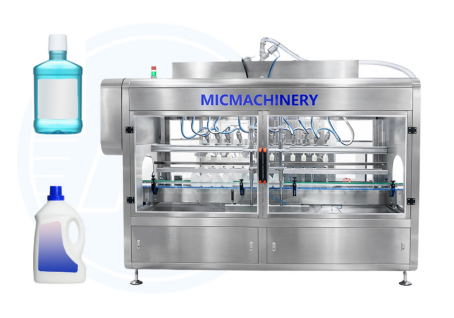
Your packaging format is the biggest driver of machine selection. Bottles with pump or flip caps are filled and capped by piston, gravity, or rotary machines. Stand-up pouches with spouts need a dedicated pouch filling and capping machine. Industrial pails of 5–30L require a weighing-based filler for accurate large fills. The images below show typical detergent machines matched to their container formats.


Semi-Automatic or Fully Automatic?
For a start-up or a lab, a semi-automatic piston filling machine is an economical entry point — it is flexible, easy to clean, and ideal for small batches. Once your order volume grows, a fully automatic detergent filling machine pays for itself through consistent accuracy, lower labor costs, and higher throughput. Many manufacturers, including MIC Machinery, offer both and can integrate a full line for you.
Final Thoughts
Choosing a detergent filling machine is about matching the machine to your detergent viscosity, packaging format, target output, and budget — while keeping foam control and filling accuracy at the center of your decision. Use the comparison tables above as a shortlist, and always validate the machine parameters against your real production SKUs before purchasing. Need a custom filling solution? Contact us to get selection advice and a tailored quotation for your detergent production line.
Frequently Asked Questions
What is the best filling machine for liquid detergent?
For thin laundry detergent in bottles, a gravity or high-speed servo filling machine works well. For thicker liquid detergents, a piston filling machine provides better accuracy. The best filling machine for liquid detergent depends on your viscosity and output — see the comparison in Table 1.
How accurate is a detergent filling machine?
Modern piston and weighing machines achieve filling accuracy of roughly ±0.5–1% of target volume, while weighing-based pail filling can reach ±0.1–0.5%. Accuracy is the key reason to invest in a quality liquid detergent filling machine.
How much does a detergent filling machine cost?
Cost ranges widely with configuration: semi-automatic piston fillers are the most affordable, while fully automatic, multi-head gravity or rotary pouch lines cost significantly more. Contact a manufacturer for a quotation matched to your speed and container requirements.
Can one filling machine fill both bottles and pouches?
Generally no. Bottle filling machines and pouch filling machines use different architectures (nozzle/dosing vs. pouch forming and spout capping). You should choose a filling machine for liquid detergent matched to your specific packaging format, or install separate lines.
How do I prevent foam when filling detergent?
Use a machine with anti-foam filling performance — bottom-up filling nozzles and controlled flow rates. This is a defining feature of a purpose-built detergent filling machine versus a general-purpose liquid filler.
How fast can a detergent filling machine fill bottles?
An 8-head piston machine reaches about 2,000–2,400 BPH at 1L, a 12-head gravity machine 2,400–2,800 BPH, and a high-speed tracking machine up to 3,000 BPH at 500ml. Speed should be matched to your annual volume and container size.