How Do You Prevent Paint Pigments from Settling During Filling?
How Do You Prevent Paint Pigments from Settling During Filling?
You stop pigment settling before the nozzle, not at it. Keep the paint mixed and moving with proper agitation, a controlled holding window, and a supply line designed for the paint's flow — then a correctly chosen paint filling machine feeds a uniform mixture into every container. Below we break down the paint filling machine working principle, the full paint filling process, why paint pigment settling happens, and the practical steps to prevent pigment settling on your line.
Short answer: pigment settling is controlled upstream — by agitation, holding-time limits, and a well-designed material transfer system. The filling machine keeps dosing accurate, but it cannot fix a paint that has already separated before it reaches the nozzle.
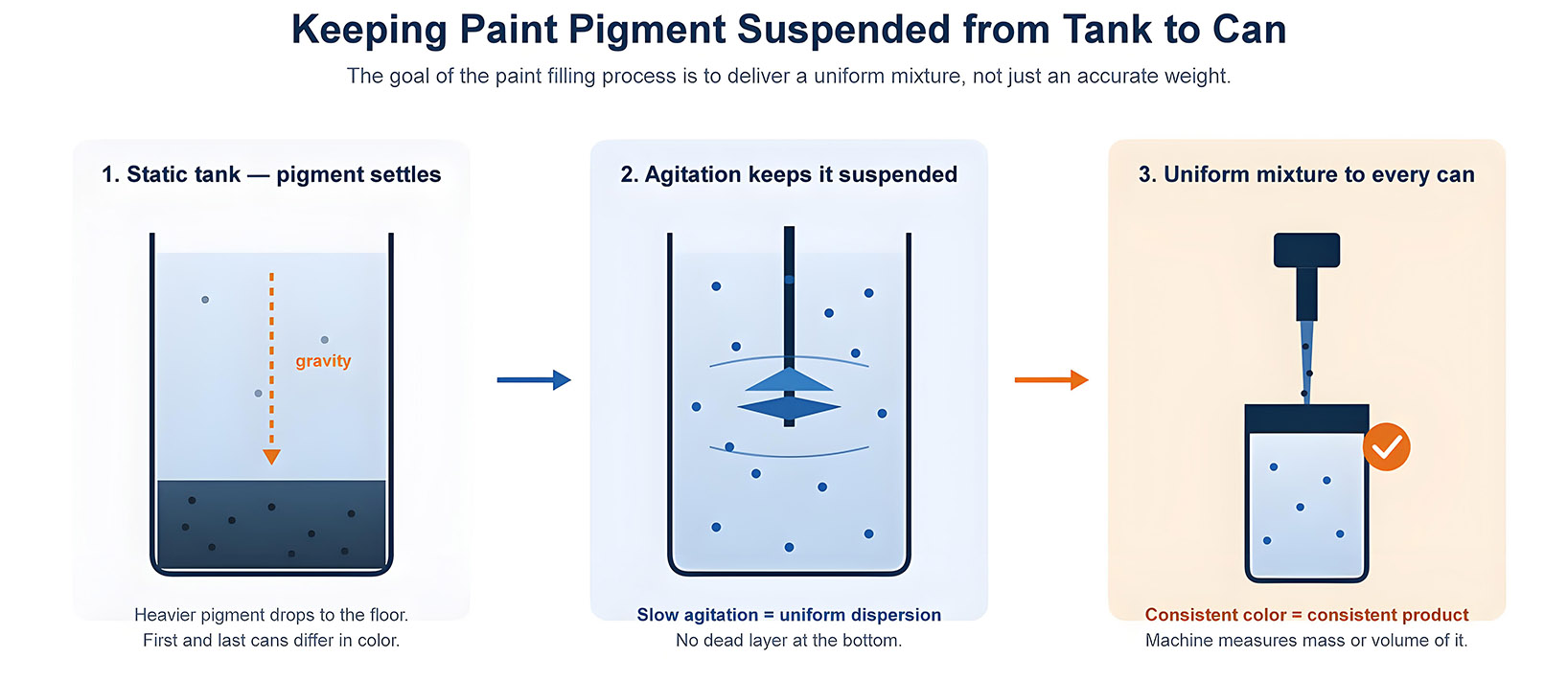
Why Does Paint Pigment Settling Happen During Filling?
A paint recipe is not a single liquid. It usually carries pigments, fillers, a resin binder, solvent or water, dispersants, and a handful of additives. Those ingredients have different densities and particle sizes, so gravity pulls the heavier, solid particles toward the bottom whenever the mix sits still. Once separation starts, the first cans off the line and the last cans off the line can hold noticeably different pigment levels — even though every can hits the same target weight.
Particle size, density and viscosity
Large or dense pigment particles drop faster than fine, well-dispersed ones. The thickness (viscosity) of the liquid phase and how well the pigment is dispersed both slow that drop. Thicker paint settles more slowly, but simply cranking up viscosity is not a free fix: a formulation that holds pigment in storage may become hard to pump, hard to apply, or slow to fill. Storage stability, application performance, and pumpability all have to be balanced in the recipe.
Holding time and weak agitation
When a tank stands idle, particles keep accumulating near the floor. If the first containers draw from a thinner layer than the last containers, the batch is uneven before the filler ever sees it. The answer is a defined mixing and holding routine — agitator speed, impeller shape, tank geometry, and mixing time should come from testing your actual paint, not from a generic timer.
The supply line itself
Even a perfectly mixed tank can lose uniformity once the paint travels through pipes. Long dead legs, low-flow pockets, wrong pump arrangements, or a poor outlet design let the paint separate again on the way to the filling head. Treat the filler as part of one material-handling system, not as an isolated island.
The Paint Filling Machine Working Principle
The working principle depends on the metering method — piston, gravity, tracking, or weight-based — but the overall sequence is the same across them. Prepared paint is fed from a mixing or holding tank into the filler. Containers are positioned under the filling heads, sensors confirm alignment, and the control system starts the dosing cycle. The machine dispenses a preset volume or target weight, closes the valve, and moves the filled container to capping and labeling.
Two things make the principle work for pigmented paint. First, the filler must receive paint of a representative, consistent composition — the upstream conditioning matters more than the nozzle geometry. Second, accurate metering and consistent material supply have to be designed together. A load cell can weigh a container correctly even when the paint inside it is uneven; a volumetric piston can repeat the same volume without correcting a separated formulation. The machine measures what arrives at it. It does not re-mix the paint.
The Paint Filling Process, Step by Step
Reading the line end to end shows exactly where settling can creep in. The steps marked (control point) are where you actively control material uniformity; the rest is metering and packaging.
-
Mix and disperse — Prepare the paint to the approved formulation and dispersion procedure. Pigment must be fully wetted and broken up before it reaches the line.
-
Hold and agitate — Keep slow agitation running in the holding tank or buffer hopper. This is the single biggest lever against pigment settling during the run.
-
Controlled transfer — Feed paint through a compatible pump and short, clean pipeline with no dead pockets. For recirculating systems, design the return line to keep the pattern moving.
-
Position the container. Sensors detect and align each can, pail, or drum under the filling head before dosing starts.
-
Meter and fill. Dispense the target volume or weight. Large containers often use two-stage filling — fast first, slow near the target — to cut splash and overshoot.
-
Cut off and transfer. Anti-drip nozzles close cleanly; bottom-up filling helps on thick paints to reduce trapped air.
-
Seal and inspect. Lid or closure goes on, then the required quality checks: weight, appearance, and pigment consistency.
The exact order shifts with a semi-automatic versus fully automatic line, and with piston, gravity, tracking, or weight-based filling. But the conditioning in steps 1–3 is what prevents pigment settling before dosing ever starts.

How to Prevent Pigment Settling Before It Reaches the Nozzle
The most effective control happens upstream. Three moves cover most of the problem.
Run proper tank agitation
A mixing tank usually needs an agitator to keep pigment spread evenly. Too little motion lets particles settle; too much can pull air or foam into sensitive formulations. Set the speed, impeller, and tank fill level against your real product, not a default.
Set a holding-time window
Decide how long prepared paint may sit without extra mixing, and when the agitator must kick back in during production pauses. A practical operating procedure spells out the approved mixing conditions, whether agitation continues during production, the maximum validated holding time, the restart procedure after a long stop, and the checks needed before filling resumes. Those limits come from product testing — not from a universal rule of thumb.
Design the outlet and recirculation correctly
The outlet should draw a representative mixture, so the filler does not end up with only the thinner top layer of a separated tank. Where recirculation is needed, size the return line to support the flow pattern without whipping in air or adding unnecessary shear. The goal is not to move paint as fast as possible; it is to deliver a well-conditioned mixture to every head for the whole run.
Common mistake: buying a more accurate filler to solve a color-uniformity complaint. If the paint composition changes mid-run, even a perfect scale will still hit target weight while the cans differ in pigment level. Fix the material first.
Which Filling Method Suits Pigment-Containing Paint?
Different metering methods have different strengths. The right one depends on paint viscosity, particle character, container format, target output, and whether you sell by volume or net weight.
| Filling method | Best fit | Dosing basis | Key watch-out |
|---|---|---|---|
| Piston | Controlled volumetric dosing of medium-viscosity paints | Fixed cylinder volume | Paint must pass the cylinder, valves, and seals reliably |
| Gravity | Free-flowing paints with good flow behavior | Volume by gravity feed | Flow and formulation must suit gravity feeding |
| Tracking | High-speed automatic filling on a moving conveyor | Volume, heads follow the container | Needs synchronized motion and a stable feed |
| Weight-based | Paints sold by net weight, especially 5–30 L pails and drums | Load-cell mass | Validate load cell, cutoff, and container stability |
[Chart: published throughput by automatic filler type — horizontal bar chart. Auto tracking (500 ml) ≈ 3,000 BPH; Bottle gravity (500 ml, 12 heads) ≈ 3,000 BPH; Auto gravity (1 L) ≈ 2,600 BPH; Piston bottle (1 L) ≈ 2,200 BPH; Piston (1 L) ≈ 1,800 BPH. Barrel fillers run separately at 150–600 containers/hour because they handle 6–30 L packages.]
For pigmented paint, a weight-based paint filling machine is often the cleaner choice on larger pails, because it measures the actual mass and stays accurate as density shifts between batches. For 50 ml–5 L cans and jerry cans on a high-speed line, the automatic tracking filler is the standard option. Either way, the machine's metering accuracy does not guarantee even pigment concentration — material conditioning and dosing control have to be addressed together.
High-Viscosity Paint and Air Bubbles
Thick coatings need more attention than thin ones. Supply, pump selection, pipe sizing, and nozzle design all matter, and some heavy paints need a positive-displacement pump instead of gravity. A bigger pump or higher pressure is not automatically the answer — too much shear can damage the product. Validate the setup with your actual formulation.
Air bubbles usually enter through mixing, a poor pump suction, turbulence in transfer, or splash at the filling point. They make visual inspection harder and can disturb the cutoff. Review the mixing procedure, check the pump inlet and seals for air leaks, calm down the transfer flow, and adjust nozzle depth and speed for the container shape. Not every paint needs vacuum deaeration, and not every visible bubble means the filler is at fault.
MIC Paint Filling Equipment — Reference Parameters
The table below lists published figures from MIC Machinery's machine families. Treat them as reference ranges, not as a promise that every configuration handles every pigmented paint. Run product trials when viscosity, suspended solids, settling behavior, or cleaning requirements are significant.
|
Product |
||||||||
| Filling Head | 8 | 12 | 4 | 4 | 8 | 4/6/8/12/20 | / | 2 |
| Filling Volume | 100ml-1000ml / 200ml-2000ml / 300ml-3000ml / 500ml-5000ml | 50ml - 5000ml | 50ml-5L | 5L-30L | 50-1000ml (1000ml piston cylinder) | 500-5000ml | 200KG and 1000KG | 6-30L |
| Fiing speed | 2000-2400 BPH (1L) | 2400-2800 BPH (1L) | 3000 BPH (500ml) | 200-600 barrels/hour | ≤1800 BPH (1000ml bottle) | 3000 bottles/hour (12 nozzles, 500ml) |
20-30 drums/hour(for 200kg) or 8-10 tanks/hours (for 1000kg) |
150-320 barrel/hour |
| Gas Consumption | 0.6m³/min | 0.6m³/min | / | 0.6m³/min | / | 0.6m³/min | / | / |
| Working Pressure | 0.55-0.65Mpa | 0.55-0.65Mpa | 0.6-0.8Mpa | 0.55-0.65Mpa | 0.55-0.65Mpa | / | / | / |
| Machine Power | 4.5KW | 2KW | 9KW | 4kw | 3KW | 1.5KW | 7.5kW | 4 KW |
| Weight | 800kg | 800kg | 850KG | 700KG | 1000kg | 900KG | 260 kg | 180kg |
| Dimension (L*W*H) | 1800*1400*2300mm | 2000*1200*2200mm | 2400*2000*2300mm | 2500*1600*2300mm | 2000*400*2500mm | 2300*1300*2200mm | 1400*2300*2200mm | 900*1100*1500mm |
Frequently Asked Questions
Why do paint pigments settle during filling?
Pigments settle when the recipe is not stable enough, or when mixing, holding, and transfer fail to keep the dispersion uniform. Identify the root cause before you change any filling parameter — the problem is usually upstream of the nozzle.
Can a paint filling machine stop pigment settling by itself?
No. The filler supports consistent dosing, but it cannot stabilize every formulation on its own. Agitation, recirculation, and material handling have to be controlled upstream; the machine weighs or volumes what arrives at it.
What is the paint filling machine working principle?
Paint is fed from a mixing or holding tank, containers are positioned under the heads, and the control system doses a preset volume (piston, gravity, or tracking) or target weight (load cell), then closes the valve and moves the container to sealing. The method changes the metering basis, not the overall sequence.
Does high-viscosity paint need a special filling machine?
Not always, but thick paint may need a compatible positive-displacement pump, suitable pipework, correctly sized nozzles, and a controlled filling cycle. Test with the actual product before you commit to a configuration.
Is a weight-based filling machine better for paint?
It helps when packages are sold by net weight or when weight-based control fits the process, especially on 5–30 L pails. It does not replace proper mixing, and it cannot stop pigment separation by itself.
How do I tell pigment settling apart from filling inaccuracy?
Compare weights with product-quality checks. Stable package weights combined with shifting pigment level point to a material-conditioning problem. Fluctuating weights with uniform paint point toward the dosing system, sensors, or cutoff control.
Keep the paint uniform from tank to container
Preventing pigment settling is a coordinated job across preparation, agitation, holding time, transfer, and filling control. Pick the right machine, but make sure the paint reaches the filling head already uniform.