What Factors Should You Consider Before Buying a Lotion Filling Machine?
What Factors Should You Consider Before Buying a Lotion Filling Machine?
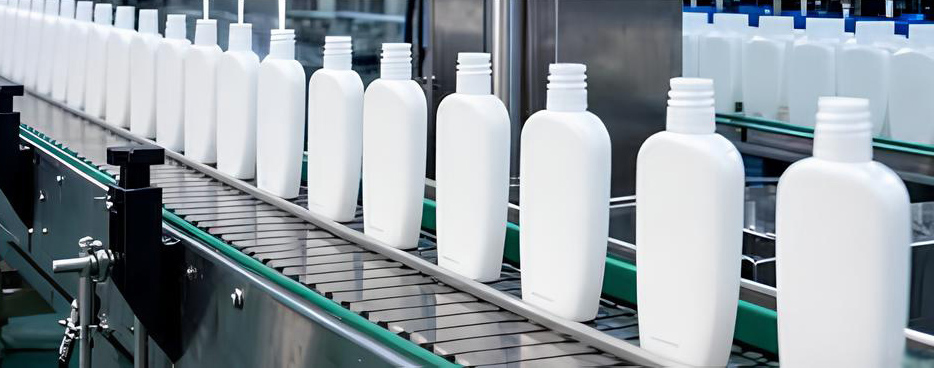
Lotion products are widely used in skincare, personal care, and cosmetic industries, but their semi-liquid characteristics make filling more challenging than low-viscosity liquids. Differences in viscosity, temperature, particle content, and formulation stability directly influence filling speed and accuracy.
A suitable Lotion Filling Machine should match the physical properties of the product while meeting requirements for hygiene, production capacity, and packaging compatibility. MIC Machinery designs an automatic lotion filling machine for body lotion, hand lotion, sunscreen, moisturizing cream, and other cosmetic emulsions, helping manufacturers achieve stable dosing and efficient packaging processes.
How to Choose a Lotion Filling Machine for Cosmetic Production?
Selecting filling equipment requires more than considering output speed. Manufacturers should evaluate product characteristics and production conditions before purchasing.
|
Selection Factor |
Important Consideration |
|
Product viscosity |
Determines filling method and material transfer performance |
|
Filling range |
Influences piston size and dosing control |
|
Container type |
Ensures compatibility with bottles, jars, or pump packaging |
|
Production capacity |
Defines the required number of filling heads |
For cosmetic manufacturers, piston filling technology is commonly selected because it provides stable volumetric measurement for medium-viscosity products. Servo-controlled systems are also available when higher precision and flexible adjustment are required.
Why Does Lotion Viscosity Affect Filling Performance?
Viscosity is one of the most important parameters in cosmetic filling. A lotion with unstable viscosity may cause slow filling, air bubbles, dripping, or inconsistent levels between containers.
A high viscosity lotion filling machine is designed for thicker cosmetic materials that require stronger pushing force during transfer. The filling system must maintain smooth product flow without damaging the formulation structure.
During production, the material normally moves through several stages:
1)Mixing and viscosity adjustment in the preparation tank
2)Transfer through hygienic pipelines
3)Buffer storage before filling
4)Precision dosing into containers
5 ) Sealing, capping, and labeling processes
How Does a Piston Filling System Handle Cosmetic Materials?
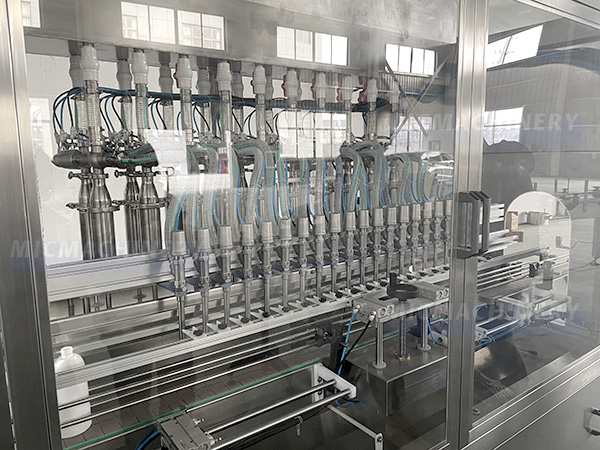
A piston filling system controls product volume through mechanical displacement. The piston draws a fixed amount of material and transfers it into containers through filling nozzles.
|
This technology is suitable for lotions because it can handle materials with different flow characteristics while maintaining consistent dosing. ----- Key features include: · Adjustable filling volume · Stable material suction and discharge · Reduced product residue · Easy cleaning and maintenance ----- MIC Machinery filling systems use stainless steel contact parts, PLC control, and adjustable filling parameters for different cosmetic formulations. |
 |
How Do Filling Nozzles Improve Production Quality?
The nozzle design affects cleanliness and product appearance after filling. Anti-drip structures help prevent residue on bottle openings, while adjustable nozzle positions support different container heights.
For manufacturers producing multiple skincare products, quick adjustment reduces downtime during product changeover.
Filling Accuracy
Accurate dosing directly affects product cost control and packaging consistency. In cosmetic production, even small filling variations may increase material waste when operating at high volumes.
MIC filling systems achieve stable accuracy through controlled piston movement, precise sensors, and optimized parameters. The final performance depends on product viscosity, filling volume, and machine configuration.
| Parameter | Reference |
| Filling accuracy | ≥99% |
| Filling volume | Customized according to production needs |
| Contact material | Stainless steel |
| Control system | PLC |
Lotion Filling Machine vs Cream Filling Machine
Although both machines are used for cosmetic products, their working conditions are different.
| Feature | Lotion Filling Machine | Cream Filling Machine |
| Material property | Medium viscosity emulsion | Higher viscosity paste |
| Typical technology | Gravity or piston filling | Piston filling with stronger force |
| Products | Body lotion, sunscreen, moisturizer | Face cream, hand cream |
When a factory produces both product types, selecting a flexible filling system can reduce equipment investment and simplify production management.
FAQ
| What information should be provided when requesting a filling machine quotation? |
| Manufacturers should provide product type, viscosity range, bottle specifications, filling volume, target output, and automation requirements. These details allow accurate equipment configuration. |
| How is a new filling machine tested before production? |
| Before operation, engineers check electrical connections, pneumatic systems, filling parameters, and trial production results to confirm stable performance. |
| Can the machine be integrated with other packaging equipment? |
| Yes. The filling unit can be connected with capping machines, labeling machines, conveyors, and complete cosmetic packaging lines. |
| What maintenance helps prevent filling problems? |
| Regular cleaning of nozzles, inspection of seals, lubrication of moving parts, and checking air pressure help maintain long-term operating stability. |
| What causes uneven lotion filling? |
| Common causes include inconsistent material viscosity, incorrect parameter settings, nozzle blockage, or unstable air supply. |