What Filling Machine Is Best for High-Viscosity Lube Oil? Mic Machinery
What Filling Machine Is Best for High-Viscosity Lube Oil?
Choosing a filling machine for high viscosity lube oil depends mainly on the oil’s viscosity, filling volume, container size, required filling accuracy, and production speed. For many high-viscosity lubricants, a piston filling machine is a practical choice because it provides controlled volumetric dosing, while a gear pump system can be suitable when continuous and stable product transfer is required. For particularly temperature-sensitive or difficult-to-flow lubricants, a heated filling system may also improve filling consistency. The right solution should therefore be selected according to the product and production requirements rather than viscosity alone.
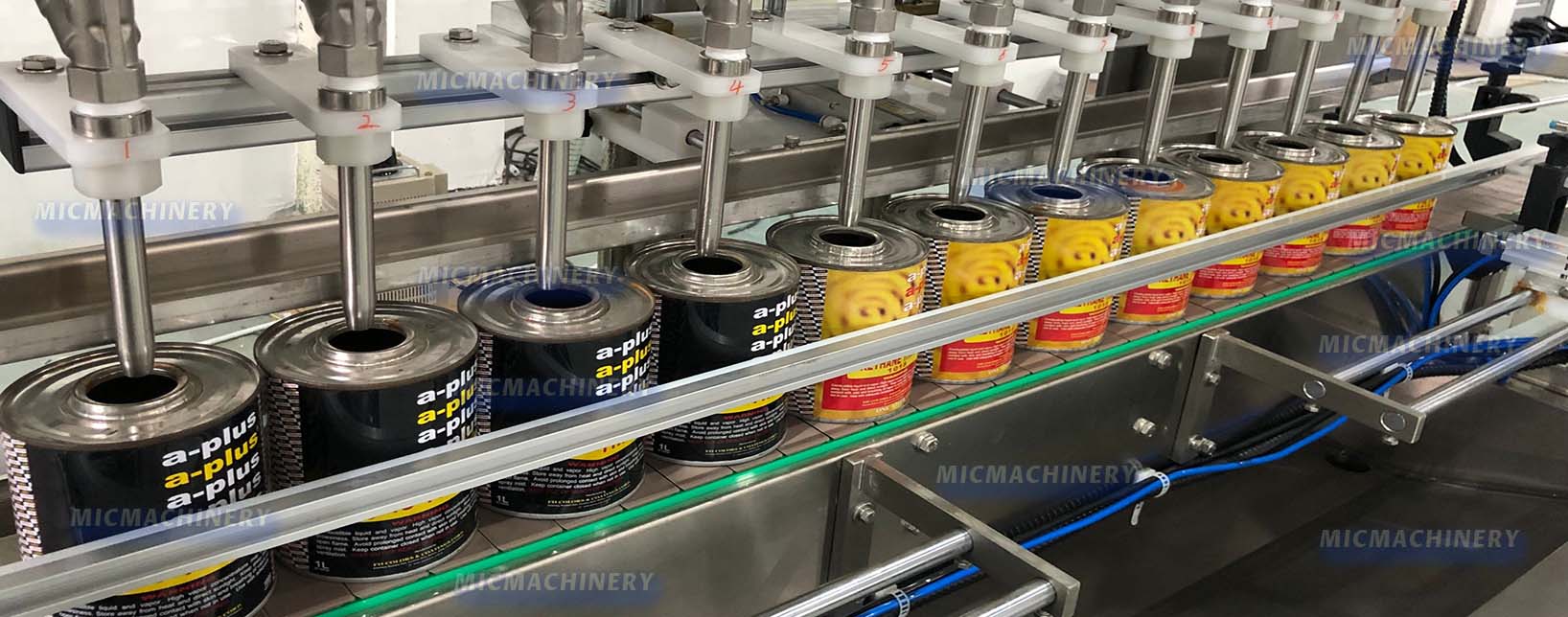
Why Does High-Viscosity Lube Oil Require Special Filling Equipment?
High-viscosity lubricants do not flow through pipes, valves, pumps, and nozzles as easily as low-viscosity liquids. When the oil becomes thicker, filling speed can decrease and residual product may remain inside the filling nozzle or pipeline.
Typical products include gear oil, heavy engine oils, transmission fluids, hydraulic oils, and other industrial lubricants. MIC's lube oil filling solutions are designed for different lubricant grades, container formats, and production scales, with configurations including piston, gravity, weighing, and tracking filling systems.
The main factors to evaluate are:
-
Oil viscosity and temperature sensitivity
-
Required filling volume
-
Bottle or container size
-
Target production capacity
-
Required filling accuracy
-
Product changeover frequency
-
Risk of dripping or foaming
-
Whether heating is required
How Does Viscosity Affect Filling?
Higher viscosity generally means greater resistance to flow. If the filling system is not correctly matched to the lubricant, the result can include slow filling, inconsistent dosing, dripping, or excessive product residue.
For this reason, a filling machine should be tested with the actual lubricant before final equipment selection.
Which Filling Method Is Best for High-Viscosity Lube Oil?
There is no single filling principle that is best for every lubricant. The choice should match viscosity, volume, speed, and accuracy requirements.
|
Product |
||||||||||
| Filling Head | 8 | 12 | 4 | / | 6 | 4 | 8 | 4/6/8/12/20 | / | 2 |
| Filling Volume | 100ml-1000ml / 200ml-2000ml / 300ml-3000ml / 500ml-5000ml | 50ml - 5000ml | 50ml-5L | 200ml-2000ml (one time filling) | 50ml-250ml or 250ml-500ml | 5L-30L | 50-1000ml (1000ml piston cylinder) | 500-5000ml | 200KG and 1000KG | 6-30L |
| Fiing speed | 2000-2400 BPH (1L) | 2400-2800 BPH (1L) | 3000 BPH (500ml) | ≤2000 pouches/hour (500ml) | 90-100 pouches/min | 200-600 barrels/hour | ≤1800 BPH (1000ml bottle) | 3000 bottles/hour (12 nozzles, 500ml) |
20-30 drums/hour(for 200kg) or 8-10 tanks/hours (for 1000kg) |
150-320 barrel/hour |
| Gas Consumption | 0.6m³/min | 0.6m³/min | / | / | / | 0.6m³/min | / | 0.6m³/min | / | / |
| Working Pressure | 0.55-0.65Mpa | 0.55-0.65Mpa | 0.6-0.8Mpa | 0.55-0.65Mpa | 0.6-0.7Mpa | 0.55-0.65Mpa | 0.55-0.65Mpa | / | / | / |
| Machine Power | 4.5KW | 2KW | 9KW | 4KW (included in Voltage) | 5KW | 4kw | 3KW | 1.5KW | 7.5kW | 4 KW |
| Weight | 800kg | 800kg | 850KG | 2000 kg | 2000kg | 700KG | 1000kg | 900KG | 260 kg | 180kg |
| Dimension (L*W*H) | 1800*1400*2300mm | 2000*1200*2200mm | 2400*2000*2300mm | 3800*1500*2200mm | 3500*2200*2000mm | 2500*1600*2300mm | 2000*400*2500mm | 2300*1300*2200mm | 1400*2300*2200mm | 900*1100*1500mm |
MIC's current product range includes piston, gravity, weighing, and tracking lube oil filling machines. The listed configurations cover applications from small bottles to larger industrial containers. For example, the product table lists piston configurations for approximately 50–5,000 ml applications, weighing systems for 5–30 L, and larger barrel systems for 200 kg and 1,000 kg containers.
When Should You Choose a Piston Filling Machine?
A piston filling machine is particularly useful when accurate volumetric dosing is required for relatively viscous products. The piston draws a controlled quantity of oil into the cylinder and then discharges it into the container.
For high-viscosity lubricant applications, piston filling can provide a more controlled filling cycle than relying only on gravity. MIC's product range includes Motor Oil Piston Filling Machine and Lube Oil Piston Filling Machine configurations.
When Is a Gear Pump a Better Option?
A gear pump can be considered when the production system needs stable, controlled transfer of viscous oil from the supply system to the filling heads.
However, pump selection should not be based only on the word “viscosity.” The actual lubricant characteristics, flow requirement, temperature, filling volume, and required accuracy should be evaluated together.
For high-viscosity products, the pump and filling nozzle should also be sized to avoid unnecessary pressure fluctuations and excessive shear.
Does High-Viscosity Oil Need a Heated Filling System?
Not every high-viscosity lubricant requires heating. However, temperature can significantly influence viscosity.
When a lubricant becomes less viscous at a higher controlled temperature, it may flow more easily through the product pipeline and filling nozzle. A heated filling system can therefore be considered when the product's viscosity changes significantly with temperature and the production process permits controlled heating.
The correct approach is not to heat the product simply to increase filling speed. The supplier should first evaluate the lubricant's technical specifications, operating temperature, formulation stability, and required filling conditions.
When Should Heating Be Considered?
A heated system may be useful when:
-
The lubricant becomes difficult to pump at ambient temperature.
-
Filling speed changes significantly with temperature.
-
Stable viscosity is necessary for consistent dosing.
-
The product manufacturer specifies a controlled filling temperature.
Temperature control should be stable throughout the tank, pipeline, and filling system rather than applied only near the filling nozzle.
How Can You Improve Filling Accuracy for High-Viscosity Lube Oil?
Filling accuracy is affected by more than the filling valve itself. Product temperature, viscosity, pump stability, cylinder volume, filling speed, nozzle shut-off, and calibration can all influence the final result.
A practical selection process should consider these five areas:
1. Match the Metering Principle
Use piston, flowmeter, weighing, or another suitable metering method according to the product and required volume.
2. Stabilize Product Supply
The buffer tank and product supply system should provide stable conditions to the filling unit. MIC describes a buffer tank as part of the filling process to maintain stable supply and pressure.
3. Control Filling Speed
Very high filling speeds can increase splashing or turbulence, particularly when the lubricant enters a narrow container opening.
4. Select the Correct Nozzle
An anti-drip nozzle can help reduce residual oil after the filling cycle. Diving nozzles can also help control splashing when filling certain high-viscosity products or narrow-neck containers. MIC's process description specifically includes controlled filling speed, diving nozzles, and anti-drip valves as part of the filling cycle.
5. Calibrate the Filling System
Regular calibration helps maintain consistent dosing when filling volume, product grade, or operating conditions change.
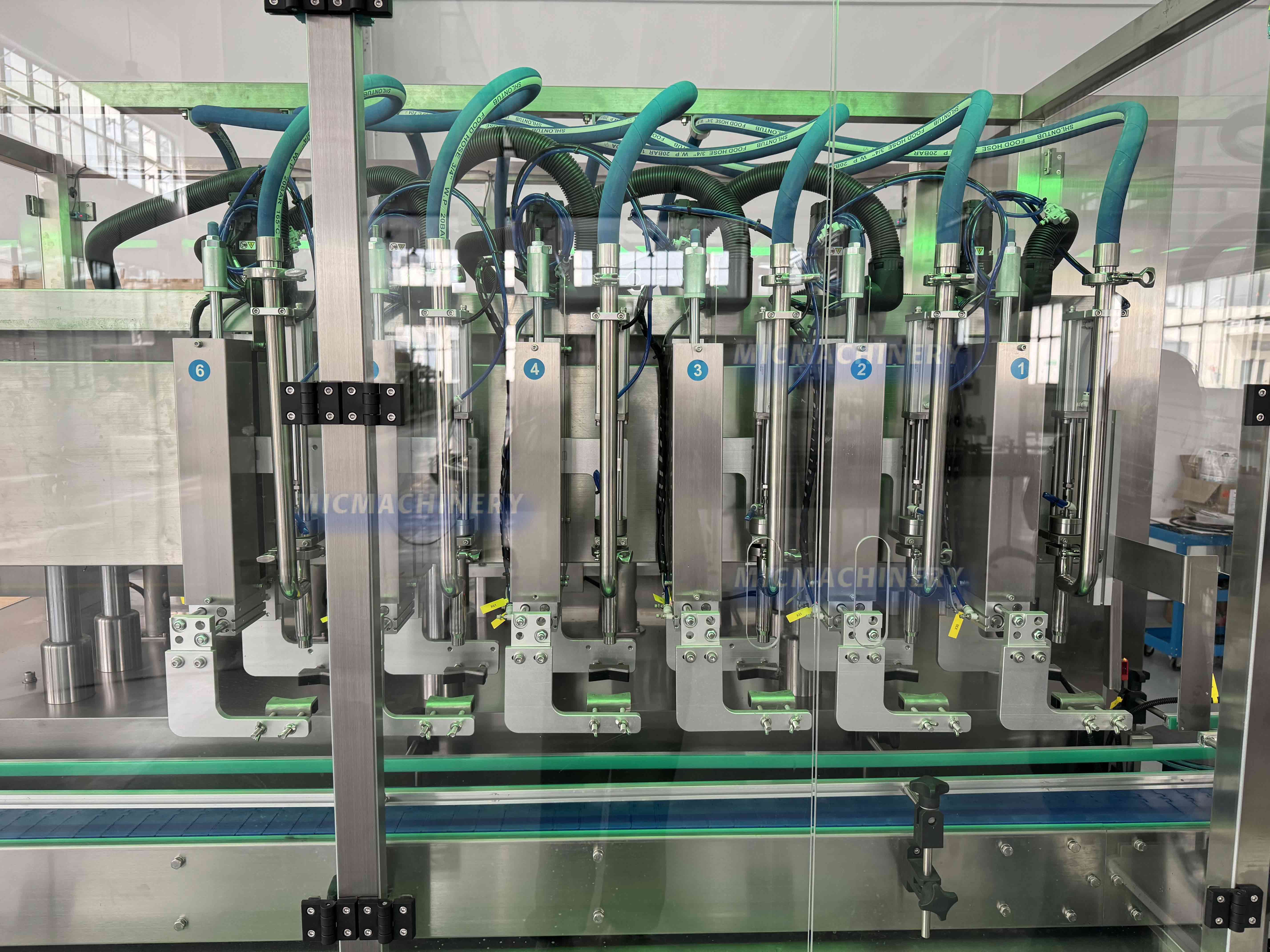
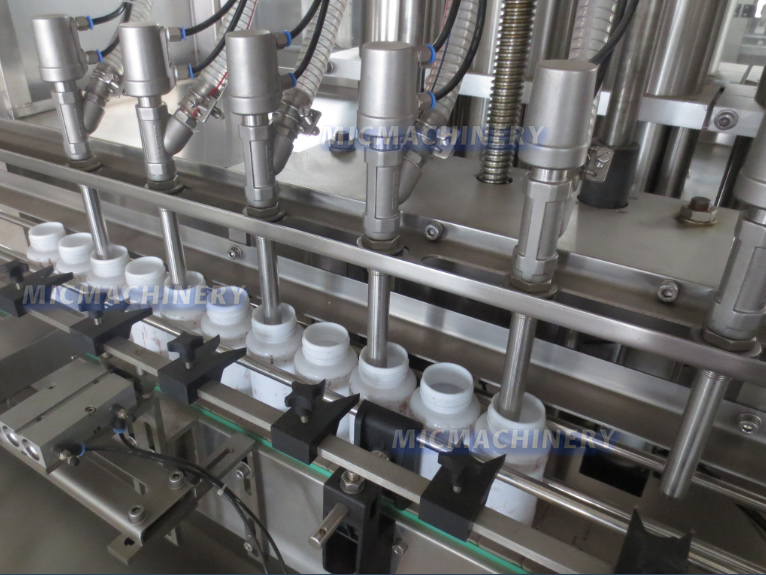
Piston Filling Machine vs. Gear Pump for High-Viscosity Oil
For buyers comparing technologies, the decision can be simplified as follows:
| Factor | Piston Filling Machine | Gear Pump System |
|---|---|---|
| High-viscosity application | Excellent candidate | Good candidate |
| Volumetric dosing | Strong | Depends on control system |
| Continuous product transfer | Moderate | Strong |
| Filling volume flexibility | Good | Good |
| High-speed production | Good with multi-head configuration | Good with suitable system |
| Maintenance | Cylinder and seals require attention | Pump and seals require attention |
| Best selection basis | Volume + viscosity + accuracy | Flow + viscosity + continuous transfer |
Neither system should be selected solely because it is marketed as a “high-viscosity filler.” The actual oil sample, target filling volume, container, speed, and accuracy requirement should be used for final validation.
How Does MIC Configure a Lube Oil Filling Line?
A complete lubricant filling line normally connects the filling machine with upstream and downstream equipment.
Typical process flow:
Lube Oil Storage Tank → Filtration / Buffer Tank → Product Supply → Bottle Feeding → Filling → Anti-Drip Nozzle → Capping → Labeling → Packing
MIC's current lube oil filling system description includes automatic container feeding, photoelectric positioning, controlled filling, anti-drip shut-off, capping, sealing, labeling, and optional palletizing integration.
Which MIC Lube Oil Filling Machine Should You Choose?
MIC provides several configurations for different production requirements. The current product range includes Motor Oil Piston Filling Machine, Automatic Engine Oil Gravity Filling Machine, Automatic Lube Oil Weighing Filling Machine, Automatic Lube Oil Tracking Filling Machine, Lube Oil Piston Filling Machine, and barrel filling solutions.
| Application Requirement | Recommended Configuration |
|---|---|
| Small/medium lubricant bottles | Piston or gravity filling |
| High-viscosity lubricant | Piston-based filling |
| Different oil grades | Flexible filling system with suitable changeover |
| High-speed bottle production | Tracking or multi-head filling |
| 5–30 L containers | Weighing filling |
| 200 kg / 1,000 kg containers | Barrel/tank weighing filling |
| Product prone to dripping | Anti-drip nozzle configuration |
| Temperature-sensitive high-viscosity oil | Heated filling system after product evaluation |
For example, MIC lists a Motor Oil Piston Filling Machine with filling ranges from 100 ml to 5,000 ml depending on cylinder configuration and a listed speed of 2,000–2,400 BPH at 1 L. Its Automatic Engine Oil Gravity Filling Machine is listed at 50–5,000 ml with a stated 2,400–2,800 BPH at 1 L. These are reference configurations; final capacity depends on the product, container, filling volume, and line configuration.
What Should You Tell a Filling Machine Supplier Before Buying?
To select the correct machine, prepare the following information:
| Required Information | Example |
|---|---|
| Product | Engine oil / gear oil / hydraulic oil |
| Viscosity | Actual product specification |
| Filling volume | 500 ml / 1 L / 5 L / 20 L |
| Container | PET / HDPE / metal can / drum |
| Target capacity | Bottles per hour |
| Filling accuracy | Required tolerance |
| Product temperature | Ambient or controlled |
| Number of products | Single grade or multiple grades |
| Automation | Semi-automatic or automatic |
| Line integration | Capping, labeling, packing |
MIC's current product page states that its lube oil systems can be configured for PET bottles, HDPE containers, metal cans, and industrial drums, depending on the machine configuration.
Providing these details before quotation allows the supplier to recommend the appropriate pump, filling principle, nozzle configuration, and line capacity rather than selecting a machine from filling speed alone.
FAQ About High-Viscosity Lube Oil Filling Machines
What filling machine is best for high-viscosity lube oil?
A piston filling machine is often a suitable starting point for high-viscosity lubricant applications because it provides controlled volumetric dosing. The final selection should consider viscosity, filling volume, container size, speed, and required filling accuracy.
Can a gear pump fill high-viscosity lube oil?
Yes, a gear pump can be considered for viscous lubricant transfer when the pump capacity and system configuration match the product. Pump selection should be validated against the actual oil characteristics and required flow rate.
Does high-viscosity lube oil require a heated filling system?
Not necessarily. Heating should be considered when temperature has a significant effect on viscosity and controlled heating is compatible with the lubricant formulation and process requirements.
How can lube oil dripping be prevented?
An anti-drip nozzle or valve, correct shut-off timing, appropriate filling speed, and suitable nozzle design can help reduce dripping and residual oil around the container opening.
Can one machine fill different grades of gear oil and engine oil?
It can be possible when the machine is configured for the relevant viscosity range, filling volumes, and product changeover requirements. Cleaning and changeover procedures should be considered when multiple lubricant grades are processed on one machine.
What bottle sizes can a lube oil filling machine handle?
The suitable range depends on the selected filling system. MIC currently lists configurations covering small bottles through 5 L applications and weighing systems for approximately 5–30 L, with separate solutions for larger drums and tanks.
How do I choose the right lube oil filling machine?
Start with the lubricant's viscosity, filling volume, container size, target capacity, required filling accuracy, temperature conditions, and number of products. These factors determine whether piston, gravity, tracking, weighing, pump-based, or customized filling technology is appropriate.
Conclusion: Choose the Filling Principle Based on Your Oil and Production Requirements
For high viscosity lube oil, the most important purchasing decision is not simply choosing the fastest filling machine. The filling principle must match the lubricant's viscosity, filling volume, container format, production capacity, and accuracy requirement.
A piston filling machine is a strong option for controlled volumetric filling, while a gear pump can be considered for stable transfer of viscous products. A heated filling system may be useful when controlled temperature is required to maintain suitable flow characteristics. An anti-drip nozzle can further improve container cleanliness and reduce product loss.
MIC Machinery offers piston, gravity, tracking, weighing, pouch, and barrel filling configurations for lubricant packaging, allowing the filling system to be matched to different product and production requirements.