Chemical Filling Equipment——Industrial Liquid & Chemical Packaging Systems
Chemical production covers a wide range of industries, from daily chemical products and agrochemicals to industrial lubricants and corrosive solutions. Each category brings its own challenges in viscosity, chemical compatibility, safety requirements, and filling accuracy. Because of this complexity, a single standard filling solution is rarely sufficient.
The Chemical Filling Equipment developed by MIC Machinery is designed as a flexible industrial platform capable of handling different types of liquid chemicals with stable performance and reliable dosing control. It is widely used in chemical manufacturing plants, OEM filling factories, daily chemical production lines, and industrial packaging facilities where multiple product types are processed on shared equipment.
Unlike conventional liquid fillers, chemical filling systems must balance corrosion resistance, precision control, safety design, and adaptability to different formulations. The equipment is engineered to maintain consistent performance across a wide range of chemical properties, from low-viscosity solvents to high-viscosity pastes and aggressive corrosive liquids.
The chemical filling process begins with raw material preparation in a mixing or storage tank. Depending on the product type, chemicals may require continuous agitation, temperature control, or sealed storage to maintain stability and prevent separation or degradation.
Once stabilized, the chemical solution is transferred into a buffer tank connected to the filling system. This tank ensures a steady and controlled supply of material while minimizing air exposure. For volatile or corrosive chemicals, sealed or closed-loop systems are often used to improve safety and product integrity.
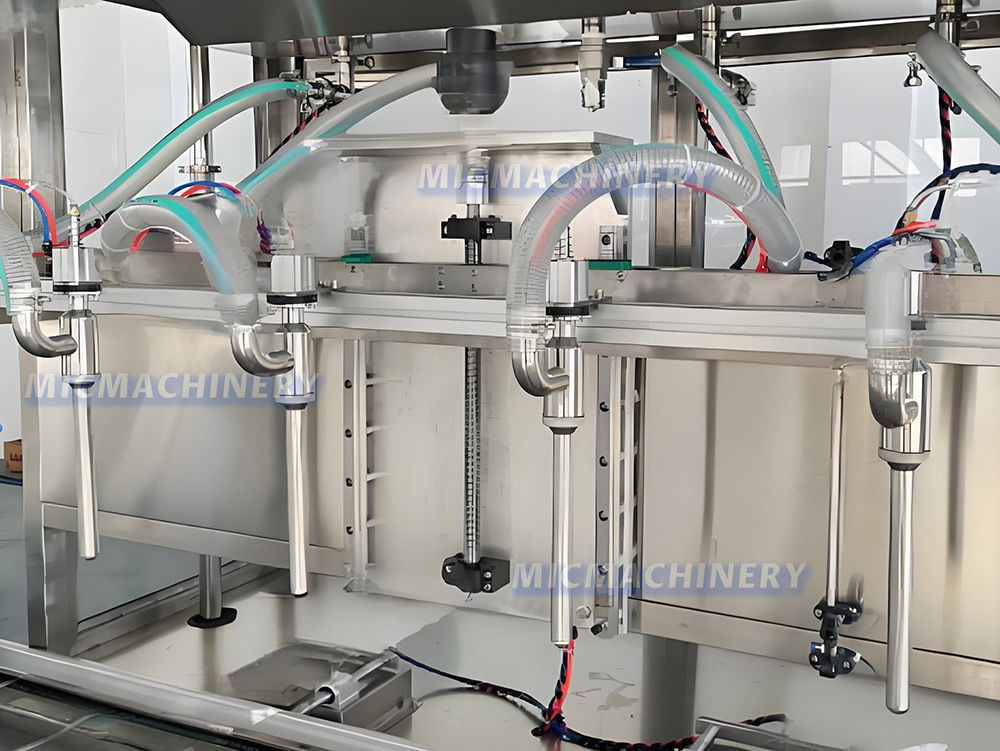
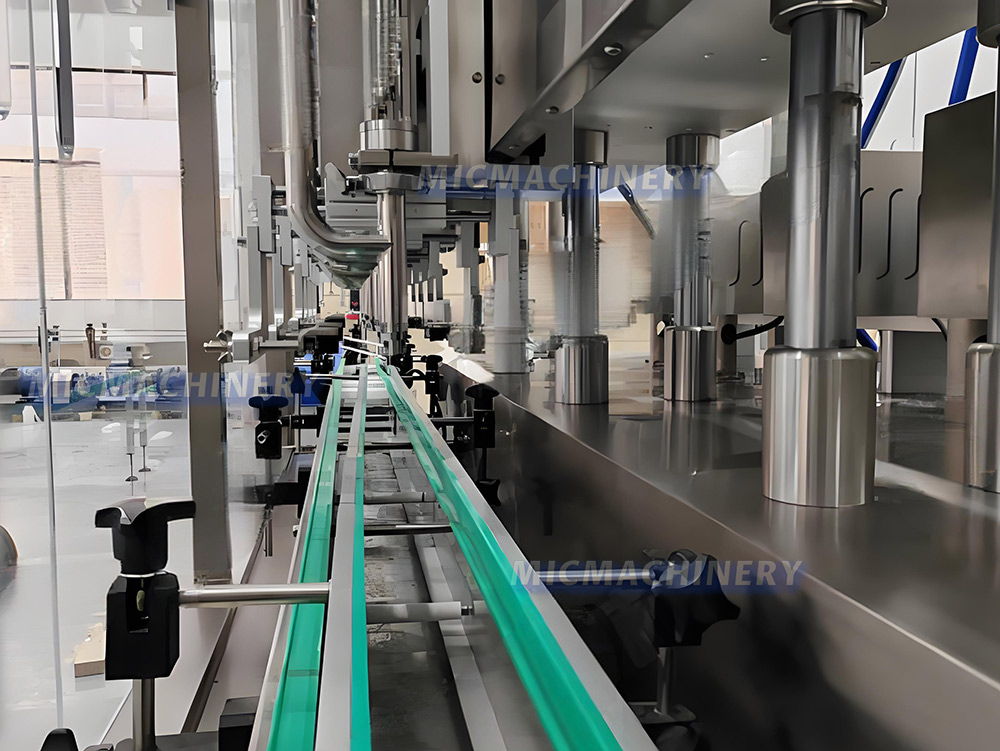
Empty containers are automatically transported into the filling station and positioned precisely under each nozzle. Sensor-based alignment ensures that each bottle is correctly placed before filling begins. The filling system then dispenses a precise volume of chemical using the selected technology—flowmeter, piston, or gravity.
Diving nozzles or bottom-up filling methods are commonly used to reduce splashing, foaming, and vapor release. Once the target volume is reached, anti-drip valves close instantly to prevent leakage and maintain clean container surfaces.
After filling, containers are transferred to downstream processes such as capping, sealing, labeling, and coding. The entire workflow is coordinated through a PLC control system that synchronizes all machine movements for stable and continuous production.
Video Demonstration
Applications
The Chemical Filling Equipment is widely used across multiple industrial sectors.
Typical applications include:
Industrial chemicals
Cleaning agents and detergents
Agrochemical formulations
Lubricants and oils
Paints and coatings
Disinfectants and sanitizers
Solvents and alcohol-based liquids
Adhesives and resins
Cosmetic and personal care liquids
Water treatment chemicals
The system supports a wide range of packaging formats including bottles, jerry cans, metal containers, and industrial drums, making it suitable for both small-scale production and large industrial chemical plants.
Customization Options
Chemical production environments vary significantly, so MIC Machinery provides flexible customization options to match different process requirements.
Corrosion-Resistant System Design
SUS316L stainless steel and PTFE sealing components for aggressive chemical compatibility.
Flowmeter Precision Technology
High-accuracy non-contact filling for low-viscosity chemical liquids.
Servo Piston System
Stable volumetric control for thick or semi-solid chemical products.
Explosion-Proof Configuration
Designed for flammable or solvent-based chemical environments.
Closed Filling System
Reduces exposure to volatile or hazardous chemicals for improved safety.
Multi-Container Flexibility
Supports quick changeover between bottles, cans, and drums.
Full Production Line Integration
Compatible with unscramblers, capping systems, labeling machines, and palletizing units for full automation.
Maintenance and Operation
Chemical filling equipment operates in demanding environments where corrosion, residue buildup, and safety risks must be carefully managed. Daily maintenance includes flushing pipelines, cleaning nozzles, and removing chemical residues to prevent crystallization or blockage.
Weekly inspections should focus on seals, valves, sensor accuracy, and corrosion condition of contact parts. For aggressive chemicals, sealing materials such as PTFE and Viton should be checked regularly and replaced when necessary.
Flowmeter calibration and pneumatic system stability should also be verified to ensure consistent dosing accuracy. In explosion-proof systems, electrical components must be inspected according to safety standards.
Proper maintenance ensures long-term stability, reduces downtime, and maintains safe operation in industrial chemical environments.
FAQ
Q1: Can this equipment handle multiple chemical types? Yes. With proper cleaning and parameter adjustment, it can process different liquid chemicals.
Q2: Is it suitable for corrosive materials? Yes. SUS316L and chemical-resistant seals are used for corrosive applications.
Q3: Can it handle flammable liquids? Yes. Explosion-proof configurations are available.
Q4: What container types are supported? Bottles, cans, jerry cans, and industrial drums.
Q5: How is filling accuracy maintained? Flowmeter and servo systems ensure stable volumetric control.
Q6: Can it be integrated into a full production line? Yes. It can connect with capping, labeling, and palletizing systems.
Industrial Chemical Filling Machine from MIC Machinery
The MIC Machinery Chemical Filling Equipment is engineered as a flexible and reliable solution for modern chemical production. It is designed to handle a wide range of formulations while maintaining safety, accuracy, and long-term operational stability in industrial environments.