What Filling Machine Is Best for Shampoo Products?
What Filling Machine Is Best for Shampoo Products?| Mic Machinery
Shampoo is a daily-use product, but producing and packaging it consistently can be challenging.
Consumers mainly care about product performance, ingredients, scent, and packaging convenience. Manufacturers face more technical questions: What filling machine is best for shampoo? How can high-viscosity shampoo be filled accurately? How can manufacturers prevent foaming and product waste?
Global Shampoo Demand Creates New Filling Challenges
|
Shampoo remains a major personal-care category worldwide. IndexBox estimates global shampoo consumption at approximately 7.9 million tonnes in 2024, while Fortune Business Insights estimates the global shampoo market at $36.27 billion in 2024. Different research organizations use different market definitions, but both indicate substantial and recurring demand. ----- For manufacturers, expanding shampoo demand also means more product variants, viscosities, bottle formats, and filling requirements. |
 |
What Problems Can a Shampoo Filling Machine Solve?
Shampoo is often more viscous than water-based liquids and may foam during filling. Common production problems include:
· Foaming: Air becomes trapped during high-speed filling.
· Inaccurate dosing: Changes in viscosity, pressure, or filling conditions affect volume.
· Dripping: Residual shampoo remains on the nozzle and contaminates bottle necks.
· Slow production: High-viscosity products require controlled product flow.
· Frequent SKU changes: Different formulas may require different filling parameters.
What Filling Machine Is Best for Shampoo?
The best filling technology depends on the physical characteristics of the shampoo rather than the product name alone.
MIC Machinery offers several filling configurations for shampoo and similar personal-care liquids.
| Filling system | Published reference specification | Typical application |
| Automatic piston filling | 8 heads; 100–5,000 ml | Medium/high-viscosity shampoo |
| Automatic gravity filling | 12 heads; 50–5,000 ml | Suitable free-flowing shampoo |
| Tracking filling | 4 heads; 50 ml–5 L | Higher-speed bottle filling |
| Semi-automatic piston | 1 head; 10–5,000 ml | Small-batch production |
| Pouch filling | Up to 2,000 pouches/h at 500 ml | Shampoo refill pouches |
| Sachet filling | 1–100 g; 20–40 bags/min | Small-dose shampoo |
For detailed machine configurations and technical specifications, see the Shampoo Filling Machine product page.
How to Fill High-Viscosity Shampoo?
High-viscosity shampoo does not flow as easily as water or other low-viscosity liquids. Simply increasing pump speed may reduce filling stability and increase splashing or air entrapment.
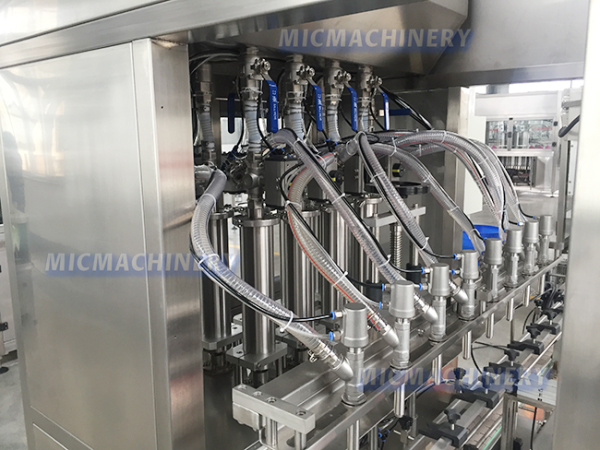 |
A piston filling system is often suitable for thicker shampoo because it uses controlled volumetric displacement. ----- For manufacturers, the key benefits include: · Consistent dosing through controlled piston movement · Adjustable filling volume for different bottle sizes · Better handling of viscous products · Reduced product waste through controlled shut-off · PLC-based parameter management for different SKUs |
However, machine selection should be confirmed through actual product testing because viscosity can vary significantly between shampoo formulas.
How to Prevent Foaming During Shampoo Filling?
Foaming is one of the most common problems in shampoo production. Surfactants can create foam when the product is exposed to excessive turbulence or air.
Manufacturers can reduce foaming by:
1)Controlling filling speed instead of simply maximizing it.
2)Optimizing nozzle positioning.
3) Using diving filling where appropriate.
4)Applying controlled filling start and stop profiles.
5)Maintaining stable product temperature and viscosity.
6)Using suitable anti-drip or anti-foam nozzle configurations.
These measures can reduce overflow, bottle-neck contamination, product waste, and inconsistent liquid levels.
Why Is Shampoo Filling Volume Inconsistent?
If a nominal 500 ml shampoo bottle repeatedly shows different fill levels, several factors should be investigated.
Product viscosity: Changes in formulation or temperature can alter flow behavior.
Air pressure: Pneumatic systems require stable operating pressure.
Piston or pump condition: Worn seals or components may affect dosing.
Nozzle condition: Residue or wear can change product flow.
Bottle positioning: Misalignment can cause splashing or inaccurate apparent fill levels.
Calibration: Filling parameters should be checked regularly during production.
A practical troubleshooting sequence is:
Viscosity → Temperature → Air Pressure → Pump/Piston → Nozzle → Bottle Position → Calibration
How Should Manufacturers Choose a Shampoo Filling Machine?
Before purchasing equipment, manufacturers should evaluate:
| Selection factor | Why it matters |
| Product viscosity | Determines suitable filling technology |
| Filling volume | Defines metering and piston/pump range |
| Foaming tendency | Influences nozzle and filling-speed design |
| Bottle format | Determines positioning and filling configuration |
| Required BPH | Determines number of filling heads and automation |
| Future SKUs | Determines flexibility and changeover requirements |
The objective is not simply to purchase the fastest machine. The right system should deliver stable filling accuracy, clean operation, reliable production, and room for future capacity expansion.
FAQ
| Can one shampoo filling machine handle different bottle sizes? |
| Yes, within the machine's designed filling range. Bottle dimensions, neck size, filling volume, and changeover requirements should be confirmed before equipment selection. |
| How can manufacturers improve shampoo filling accuracy? |
|
Maintain stable product conditions, calibrate the filling system regularly, inspect pumps and seals, maintain stable air pressure, and ensure accurate bottle positioning. |